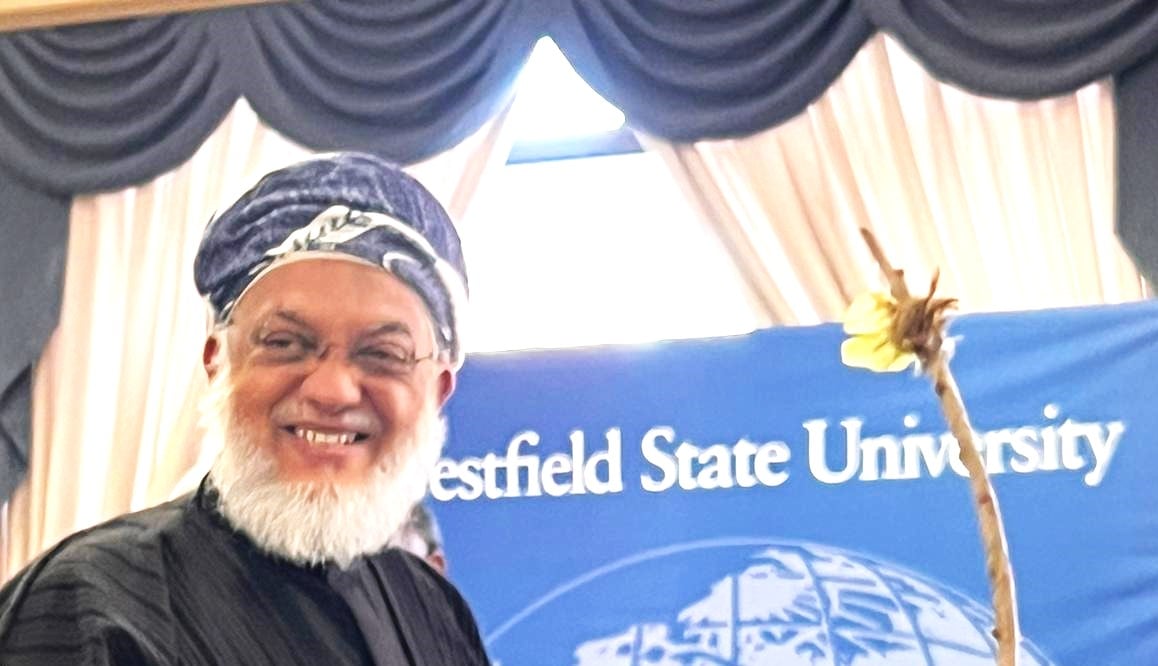
Interfaith Dialogue - Happy memories
Seven years ago, when I went to America, Interfaith Dialogue was a mystery to me. And that too, one in which I was not particularly interested. I was also very suspicious of it and wondered if it was some kind of mutual conversion tug-of-war where others would try to convert me to their faith. Or ask the usual baiting, questions with ill-disguised hostility, that you see all the time on different Islamophobic TV channels and talk-shows. Then I joined the Islamic Society of Western Massachusetts (ISWM) as the Imam where I reconnected with my dear old friend (from 1997), who became my mentor in Interfaith Dialogue work, a man of tremendous experience and great wisdom, Dr. Mohammed Saleem Bajwa.
One day he invited me to accompany him to an Interfaith Dialogue meeting. I went, trying to keep an open mind, but frankly skeptical about what I would find there. (The picture below is from another meeting many years later)
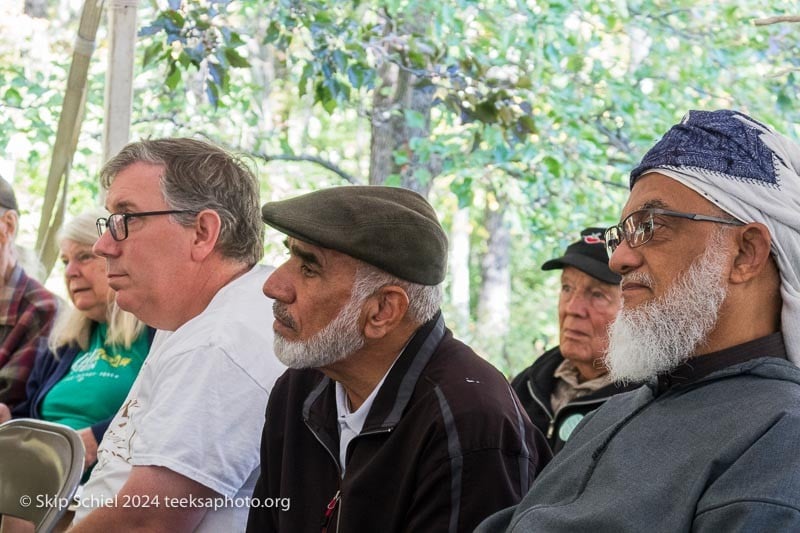
AGAPE - Day of Gratitude - Dr. Bajwa and me
This meeting was in one of the local churches and the topic was environmental protection and what we as faith leaders could do to promote it. That gave me food for thought that this was a very good way to open doors into other people’s worlds, through neutral topics of relevance to us all. Not religious preaching but dialogue on matters of mutual concern, exploring how each faith tradition can contribute to resolving them. Someone from each faith represented there, spoke about the critical need to act at our individual and collective levels to slow down global warming and positively impact climate change. Dr. Bajwa spoke on behalf of the Muslims. I watched and waited for the baiting questions, the hostility, Islamophobia, and suspicion about Islam and Muslims, which I had come, expecting to see. That never happened. I know this sounds naïve, but I am sharing frankly my experience at this first meeting. After the speeches were done, we had tea and snacks. There was no pork or alcohol. Dr. Bajwa introduced me as the Resident Scholar at ISWM. I was greeted very warmly and felt very grand. Everyone was very polite and friendly, and I left that meeting with very positive feelings, surprised that nobody argued with me or asked any contentious questions nor did anyone try to convert me. Seven years have passed since then, during which I have attended a great many meetings, been the keynote speaker in many of them, and made some very good friends. The atmosphere of Interfaith meetings has remained the same. Warm, welcoming, respectful and caring.
All good, you may say, but still, why is Interfaith Dialogue important? Let me illustrate with a story which Dr. Bajwa told me on one of our drives to a meeting. He said that it was the Friday after 9/11, when he drove into the parking lot at ISWM and noticed a few cars that he didn’t recognize. When he parked and walked into the lobby of the Masjid, he saw that there were two or three priests and a couple of doctors from one of our major hospitals, in the lobby. He greeted them and asked them what he could do for them. They said, ‘We are here because there is a possibility that after what happened in New York, some hot-headed people may try to attack the mosque. We came here to stand outside and lookout for you to make sure that nothing untoward happens. You go inside and do your prayer service. We will be here to make sure that you are all safe.’ Every time I think of this story, I marvel at it and say to myself, ‘Only in America’.
The fact is that those people were there, not because of their concern for Muslims or the mosque. They were there because of Dr. Bajwa and the bridges that he had built. They were there, ready to put themselves and their own safety on the line to protect the Masjid and the Muslims praying inside. I have never heard or seen anything like this ever. It is something that one can't even wish for or try to arrange. It can only happen when those people feel the need to act, in their own hearts. That is why Interfaith Dialogue is important because we live in a connected world and only when we know and understand one another and are willing to lookout for each other, can we be sure that we are all safe and supported. That happens by building bridges, and not walls.
To build bridges we need to learn three things:
1. Dealing with diverse people.
The most important skill to develop is to deal with people unlike ourselves. People who believe differently from us, have at least some values that are different from us, and come from a culture that is mostly alien to most Muslims. They speak English/American which for many first-generation Muslim immigrants, is not easy to understand or speak. Yet we must learn to relate to them in friendship, with respect and warmth. We need to understand the complexity of another culture and their norms and values without being judgmental about them. It is good to remember, that our Muslim culture and values are equally alien to them, with the additional burden of them having to deal with Islamophobic propaganda, in most cases, without the knowledge or experience to differentiate fact from fiction. They have nobody neutral to ask and no alternate source to verify what they hear on TV or from some anti-Muslim talk-show host. Interfaith dialogue provides that opportunity to meet a living, breathing, Muslim and ask questions or simply observe and experience their company and draw their own conclusions.
2. To be non-judgmental about their culture and beliefs.
The second most important skill, which is sometimes a challenge for some people, is to look at a different culture non-judgmentally. This can seem difficult because we come from cultures where judging is automatic and we see things in stark black and white. We must learn that the real world is nuanced and of every shade other than black and white. Being non-judgmental doesn’t mean that we need to compromise our beliefs, culture, way of life, what we eat or drink – or more correctly, what we don’t, how we dress or specific behaviors – like praying at its right time without delay, no matter where we may be. I learnt that I didn’t need to compromise on any of these things. I always dress conservatively and distinctly which became my trademark and I was recognized for it and complemented many times. I found that arrangements for Halal food, and prayer spaces, sometimes even prayer mats, were there when we attended any Interfaith gathering. In fact, the program organizers took prayer (Salah) times into account in the program timetable. Being non-judgmental does not mean giving up, compromising, watering down, hiding or disguising, our beliefs, principles, culture, traditions or ways. The culture of Interfaith is لَكُمْ دِينُكُمْ وَلِيَ دِينِ (For you is your religion, and for me is my religion).
I would say that the single, most crucial skill, is to learn to disagree without being disagreeable and to agree to disagree and move on, working with commonalities. In my seven years of attending lots of meetings, I can say that I was never put on the spot about anything or asked any question that was potentially controversial or adversarial. I was asked many times about Islam and Islamic beliefs and practices, especially when I made friends and became a standard feature with Dr. Bajwa, in all meetings, but always with great respect and genuine interest. Every year I would be invited by Dr. Ute Schmidt, the Head of the Hospital Chaplaincy Program at Baystate Medical Center, the biggest hospital in Western Massachusetts, to teach a class on Islam for priests and Rabbis training to be Hospital Chaplains. I was invited to speak about Islamic Last Rites and the concept of Resurrection and Life after Death to the Medical and Support Staff at Baystate Hospice. I was invited to speak about Islam at several schools and universities and we had regular visits by groups of schoolchildren (all non-Muslim) from many schools of our and surrounding towns. I was invited twice to teach a class on Islam at Deerfield Academy, which King Abdullah II of Jordan attended as a high-schooler. There are many more, but this will suffice for now. What should be clear is the interest in Islam and the opportunity to present it clearly and truthfully to people who want to know.
On our part, one of the most popular events that all the Interfaith Community looks forward to, is the Interfaith Iftar, that ISWM does, every Ramadan. This is an informal social gathering, very well attended, with clergy from all faiths and members of their congregations and our non-Muslim neighbors. During my tenure, thanks to the relationships that I had built, I invited several University Presidents, all of whom attended. The Mayors of Springfield and West Springfield would also be invited and always attended. There would be speeches from each faith head or representative and usually I did the keynote. Then the Adhaan would be called and everyone joined the fasting Muslims to break our fast with dates, and water. Then we would go into the Musalla area to pray Maghrib. Many of the Interfaith guests would ask to join us. Some would pray with us. Others would sit on chairs at the back of the Musalla, in deeply respectful silence, many with their heads bowed and eyes shut, listening to the recitation of the Imam, leading Salah.
Once Salah was over, we would all return to the main hall for dinner. The cuisine would be a combination of Middle Eastern, Indo-Pak and American; very delicious and hugely appreciated. The best thing about this evening is not the formal program, though that is important and enjoyable. The best thing is the informal conversations. What ordinary people say while they sit and listen to the speeches or as they eat dinner. We made it a point to encourage people to mix with others and not sit in their own faith groups. Then I would circulate and sit with them at different tables, just listening. I can't tell you how many times I have heard someone saying in effect, "This is like the sun rising after a long dark night. There is so much I didn't know. And I didn't know who to ask or even if I could ask. Thank God for this Iftar." This is the meaning of building bridges and the reason it is important.
Some guests at the Interfaith Iftar
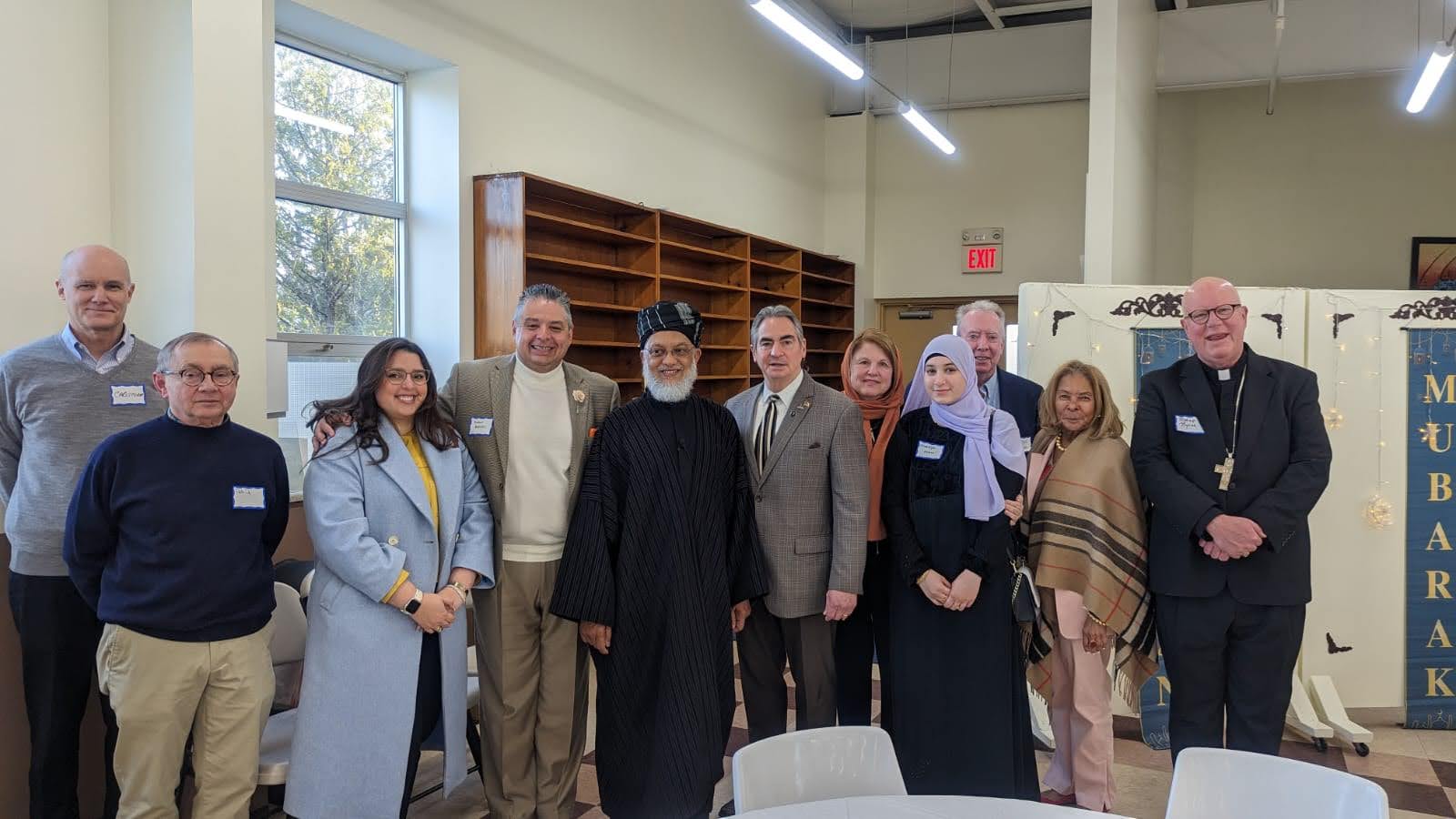
On my left is the Mayor of Springfield, Domenic Sarno. Behind him, Dr. Sandra J. Doran, President of Baypath University and her husband. At the far end, Bishop William Byrne, and next to him, Dr. Linda Thompson. The young lady is Khadija Abbasi, one of our prominent youth leaders. On my right is the President of the American International University, Dr. Hubert Benitez with his daughter, and at the far right is my very dear friend, Rev. Patrick McMahon.
3. The ability to communicate.
This needs some effort to learn but the ability to say what needs to be said in a clear but non-adversarial manner, is a huge asset. And its deficiency, a liability. There is no need to disguise or alter our message. Not even to say ‘God’, instead of Allahﷻ. Nobody demands that directly or indirectly. There is no need to change your clothing or cultural practices. On the contrary, as I said, when you look different with confidence and elegance, that is hugely appreciated and commented upon and complemented. To return to the ability to communicate, it is essential to be able to speak clearly and eloquently. The accent is not important as long as it is understandable. Nobody expects you to speak with an American accent. In fact, there is no such thing as a standard American accent. A New Yorker sounds as foreign to a Southern Californian or Texan as any foreigner. But learning to speak fluently and clearly is very important. Most of your interactions will be informal conversations. Not speeches. But those are very important as they are the key to building good relations.
4. Good manners.
Finally, people listen with their eyes and so there is no substitute for good manners. The safest guide to good manners is to be old-world conservative. Address people by their titles, until you know them well enough to use first names. Open doors and pull chairs for the ladies. ‘Thank you very much’, ‘Sorry’, ‘May I’, ‘If you don’t mind’, ‘After you’, 'I beg your pardon', (not WHAT?) and so on, are all still in vogue and please feel free to use them generously. A lesson in cross-cultural etiquette is a very good idea. I used to teach this and so this knowledge came very much in handy. But etiquette is culture specific and so it is important to learn what is appropriate and more importantly what the taboos are in that culture. Your smile is your greatest asset in Interfaith Dialogue. Use it. It’s free, but very valuable. While I always dressed in traditional Islamic attire, you can wear whatever you wish that is formal. I have always believed in the principle, if in doubt do more. Because you can take off a coat or tie, but you can’t get one if you suddenly realize that you should have worn it. The benefit of dressing like I do is that you are catapulted into the role of trend setter and so you don’t need to follow anyone. Nobody followed me but many complemented me on my attire. If nothing, it is a conversation piece.
Now, what do we say in Interfaith Dialogue meetings, you may wonder. Let me share with you two pieces to give you an idea. One is something I wrote for Grace Church, the Episcopalian Church in Amherst where I was invited to speak at a Thanksgiving meeting. I wrote a poem and recited it there. They liked it so much that they published it in their Bulletin.
We know You O! Allahﷻ by Your Bounties, uncounted
By the rays of the sun, by the light of the moon,
By the vast empty space and the stars that dwell therein,
By the rain and the snow, that help our gardens grow,
By the trees, by the fruits, by joys and sorrows,
We know You O! Allahﷻ by Your Bounties, uncounted
By the flowers in the Spring, by the dew on the rose,
By the Summer, by the colors of Fall, heralding Winter,
By the music of the brook as it plays on the rocks,
By dark skies, by falling stars, by wisdom, by stupidity,
We know You O! Allahﷻ by Your Bounties, uncounted
By the rain to give life, by sunshine likewise,
By the dewdrop on the thorn in the light of the dawn,
By the fire of sunset, as it lights up another land,
By the bugle of the stag, by the beating of my heart,
We know You O! Allahﷻ by Your Bounties, uncounted
By dreams that came true, by dreams unfulfilled,
By prayers answered, sometimes in unexpected ways,
By prayers unanswered for which we thank you today,
By parents, by siblings, by children, especially teenagers,
We know You O! Allahﷻ by Your Bounties, uncounted
By the silence of the forest and the grandeur of mountains,
By the depth of the ocean, hiding treasures unknown,
By the fish, by the birds, by the Black-capped Chickadee,
By the Cardinal in the snow, by the waiting Blue Heron,
We know You O! Allahﷻ by Your Bounties, uncounted
By the Marlin as he rises on his tail and throws the hook,
By the song of the Loon on the night of the full moon,
By the storm, by the typhoon, by Covid, and still being alive,
By waking every morning, by sleeping every night,
We know You O! Allahﷻ by Your Bounties, uncounted
By a future that looks dark, promising a dawn very bright,
By our values, our compassion, our courage, by the Truth,
By those who lift us when we fall and fight for us when we can’t,
By knowing You, loving You, thanking You and worshiping only You,
We know You O! Allahﷻ by Your Bounties, uncounted
I was the Muslim Chaplain at Springfield College and Westfield State University and a member of the Interfaith Center at Westfield State. In 2023 I was invited by Fr. Warren Savage, another dear friend, the Director of the Interfaith Center, to deliver the keynote speech at the Annual Interfaith Breakfast, which is a very well-attended and prestigious event, hosted by the Interfaith Center and attended by the President of the University and other dignitaries.
Apart from clergy of all faiths, local government officials, including Mayors of Westfield, West Springfield (my town), and Springfield are invited. Even though the majority of clergy and guests are Christian, there is no pork on the menu. The kindness and consideration of the Interfaith folks is something to admire and learn from. I have found them to be the kindest and most polite people ever. Below is my speech that year (2023).
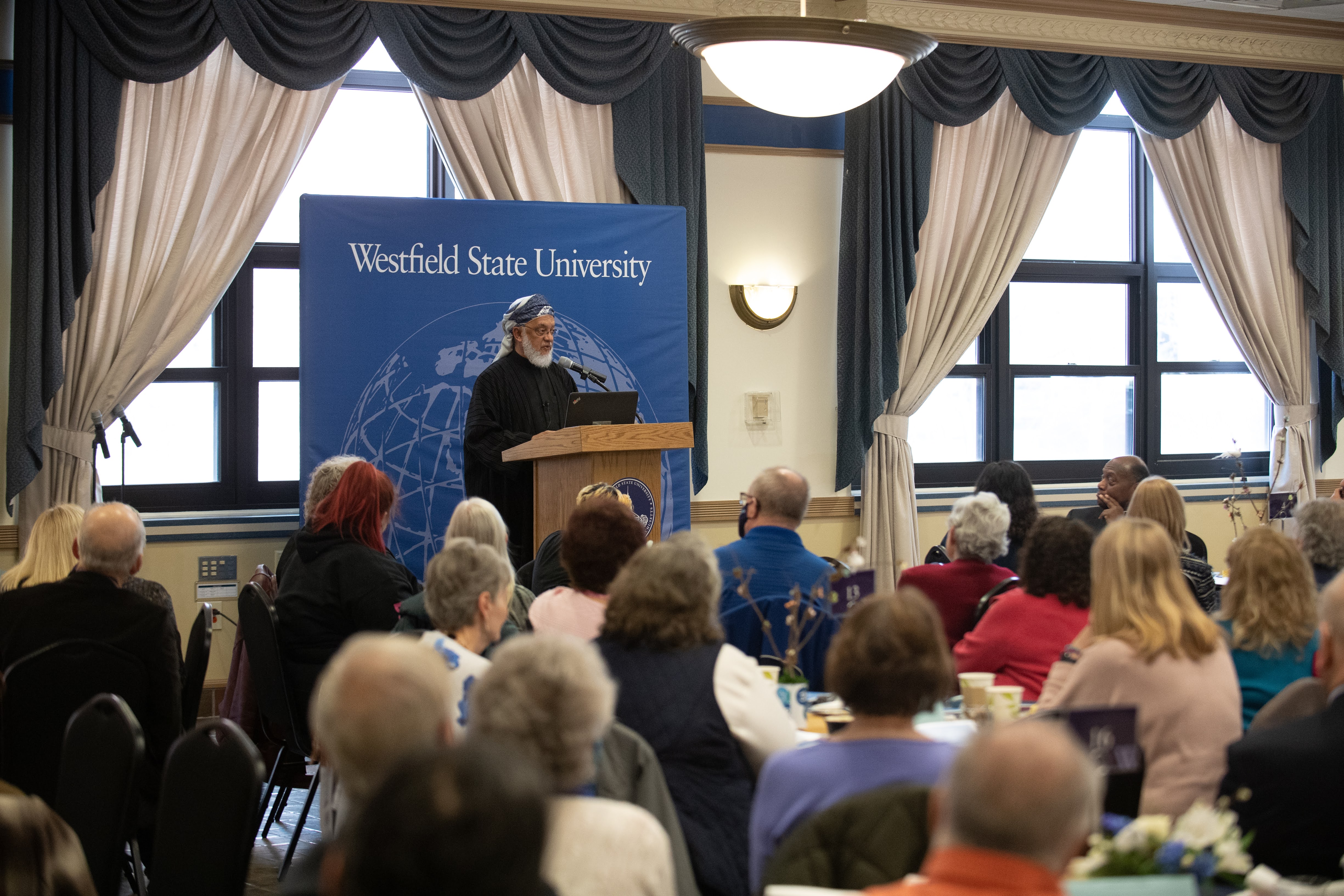
Building Bridges through appreciation
Interfaith Breakfast – Westfield State University – March 9, 2023
I am a bridge builder. And that is how I see Interfaith relations. It is the work of building bridges. It is not about taking a person from one side of the river or canyon to the other side. It is to build a bridge so that people on both sides of the river can meet. Where can they meet? On the bridge, of course.
How do you build a bridge? By making 4 – Critical Changes within yourself. Change Attitude, Perspective, Language and Behavior.
1. Change Attitude
Attitude is how we define ourselves. That depends on what we believe about ourselves. This is partly what we have been told, growing up. Conditioning. Partly what we choose to tell ourselves all through life. So, ask, ‘How do I define myself?’ Values drive Behavior. Behavior drives Results. Ask, ‘What are my values, beliefs, attitudes, stances?’ Who I AM determines what I DO which decides what I GET. We are focused on GET. Get rich, get popular, get elected, get an education, get married get, get, get. But we can only get in relation to what we do. And that depends on who we are. If we want to change what we have, we must change who we are. It is that simple.
2. Change Perspective
Perspective defines what we see. It determines our worldview which defines our responses to those who share the world with us. Allahﷻ told us:
يَـٰٓأَيُّهَا ٱلنَّاسُ إِنَّا خَلَقْنَـٰكُم مِّن ذَكَرٍ وَأُنثَىٰ وَجَعَلْنَـٰكُمْ شُعُوبًا وَقَبَآئِلَ لِتَعَارَفُوٓا۟ إِنَّ أَكْرَمَكُمْ عِندَ ٱللَّهِ أَتْقَىٰكُمْ إِنَّ ٱللَّهَ عَلِيمٌ خَبِيرٌ
Hujuraat 49: 13 O mankind! We have created you from a male and a female, and made you into nations and tribes, that you may know one another. Verily, the most honorable of you with Allah is the one who is the most pious. Verily, Allah is All-Knowing, All-Aware.
Islam tells us that we all have the same origin but are different and that the difference is a cause for celebration, for honoring one another, to recognize each other and to appreciate the different flavor we bring to the table. The difference is not a cause for discrimination or racism. Superiority in the sight of Allahﷻ is only based on piety. It is the purity of our hearts, that brings us close to Allahﷻ. And only He knows what is in our hearts.
Change your perspective and you will see another world. One that was always there, but which you perhaps couldn’t see because of where you were standing. So, ask, ‘How do I define others?’ We are raised bipolar. Everyone like us is good. Everyone unlike us is bad. We learn derogatory names for them. We learn to fear them, hate them, and to see ourselves as superior and them as inferior. This ‘othering’ is a default setting in all cultures. Only the identity of the ‘other’ differs. But there is always an ‘other’. To change this perspective, we must move from Right and Wrong to Different. Because not everything is right or wrong. Many things are just different. All prejudice is based on subjective perceptions of right and wrong. All stereotyping is based on prejudice. To cure ourselves of the cancer of prejudice, we must change our perspective.
3. Change Language
Ask, ‘How do I speak about others when they are not present? Respectfully, inclusively, appreciatively, or otherwise?’ Change language because language shapes attitudes and reflects them. I ask you to substitute one word in your vocabulary with another. Substitute TOLERATE with APPRECIATE. Tolerance implies dislike. Appreciation comes from respectful interest.
I submit to you that all healthy relationships depend on appreciation. Think tolerance or tolerating and you will not be thinking of someone you love, or a double shot of espresso, or a triple chocolate Sunday, or a glorious sunset, or your pet. You will not be thinking of anything that brings a smile to your face or a warm glow in your heart. You will be thinking, “O My God! Him again? Okay, let’s get it over with.” But when you think appreciation, you are thinking love, gratitude, missing someone, the pain of parting. You are thinking beautiful pictures, sounds, voices, dreams. So, I say to you, ‘Forget tolerating anyone. Ask, ‘How can I appreciate them?’ You can, only if you know them. So, go and make friends.
True it is that only knowledge can set us free. We must learn about others. By doing that, we learn about ourselves. So, let’s ask ourselves, ‘How much effort do I make to initiate and maintain relationships? How many friends do I have who are different from me?’ Different color, race, religion? Because it is not the color of your hair but the color of your dreams that determines success and happiness in life. From tolerance to hatred is one step. But appreciation is the opposite of hatred. So, let’s replace tolerance in our hearts and minds with appreciation.
4. Change Behavior
Behavior drives results. Collaboration is the door. Communication is the key. Ask, ‘How do I speak to myself about those who are different from me? What does my language reflect?’ Remember, not everything is spoken aloud. The most powerful messages are heard only by you because it is what you say to yourself. It is critical to reflect on this because our internal talk guides our attitude and actions. As we think, so we speak, so we act and so we get responses. Only we can change this cycle and make it a journey of discovery and friendship. For many of us, this is an unconscious process.
People are shocked when they reflect and realize what they are saying to themselves. And even more when they realize that this sets in motion a spiral that is negative or positive. The power lies in accepting that we decide what we want it to be. The solution to this is knowledge. Ask, ‘What effort do I make to learn about others?’ Remember that learning about human beings is only done by experience. Not on TV or social media but by meeting the walking, talking, breathing, warm body called _______ fill in the blank. Do that respectfully, sensitively, in a spirit of inquiry. For that, learn something about their culture, taboos, preferences, and beliefs, non-judgmentally. Judging builds walls. Walls keep people apart. Bridges draw us closer. We must be bridge builders, if we want to leave behind a world defined by love. The willingness to transcend boundaries, share uniqueness, without criticism and discrimination must be taught young, but can be learnt at any stage in life. Only one requirement…. are you willing to learn?
I want to remind you of the words of a man who had a dream for all of us.
“Cowardice asks the question - Is it safe? Expediency asks the question - Is it politic? Vanity asks the question - Is it popular? But conscience asks the question - Is it right? And there comes a time when one must take a position that is neither safe, nor politic, nor popular. But one must take it because it is right.” Dr. Martin Luther King Jr.
In conclusion, my friends, let me remind myself and you that a window opens in the life of every one of us when we can make a difference. Our window is open. Our time to create a legacy of honor, is now. When things look terrible and totally out of control and despair looms over the horizon, I say to myself: “I will not allow, what is not in my control to prevent me from doing what is in my control.”
And that is my gift to you.
During my tenure at the Islamic Society of Western Massachusetts (ISWM), I was invited to speak at many Interfaith Dialogue meetings, and the at Commencements of Springfield College and Westfield State University.
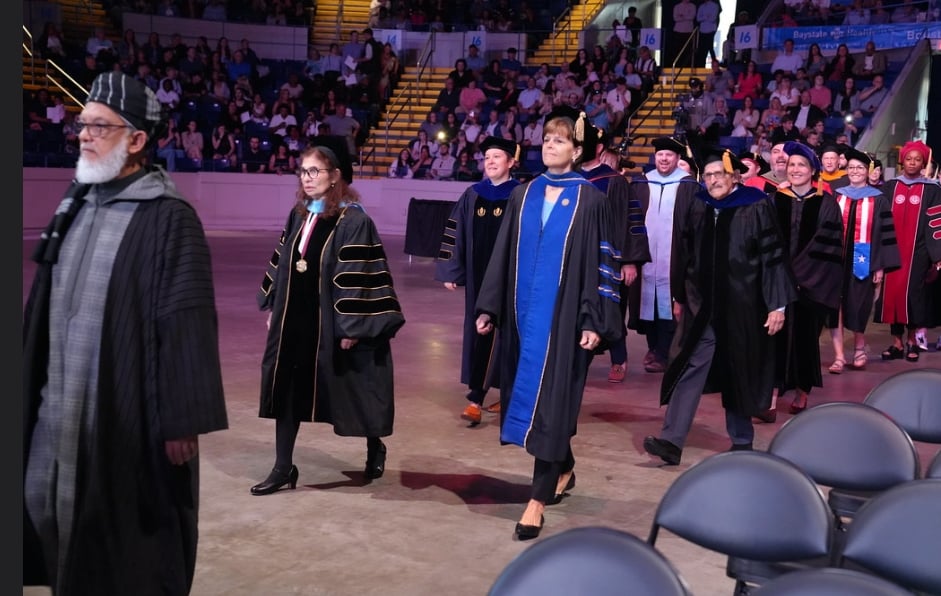
President's Procession proceeding to the stage for the Graduation and Commencement of Springfield College, May 2025
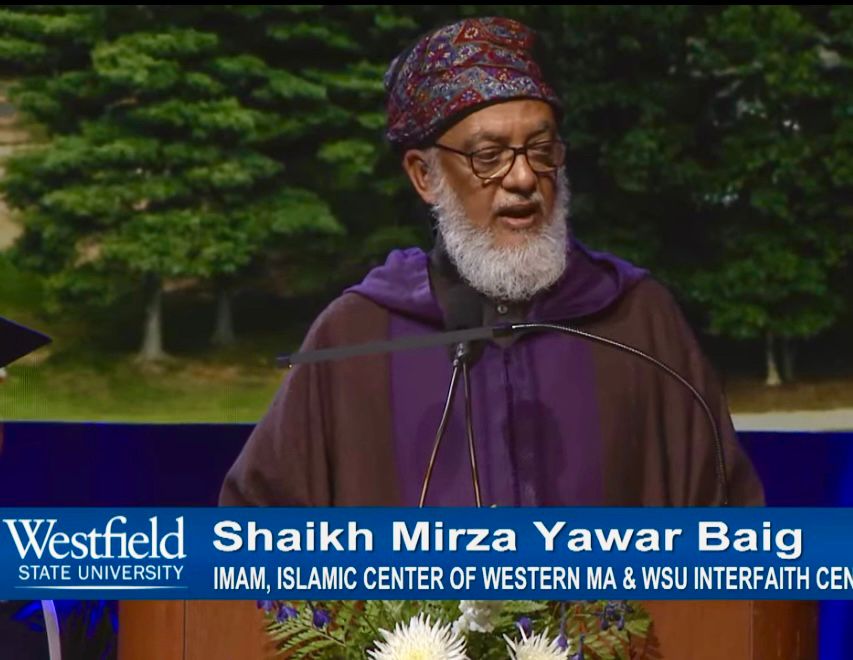
I was invited to deliver sermons at the Christchurch Cathedral, Springfield, at the Unitarian Church, Springfield, and at the First Church in Hadley. One of those sermons at Christchurch Cathedral was in Lent. About that one of my friends, who is a clergyman in Canada said, “You must be doing something right. They invited you to deliver a sermon in Lent! That is a huge sign.” And I dare say, an honor. For those who want to see/listen to it, here it is.
Sermon at Christchurch Cathedral, Springfield Massachusetts
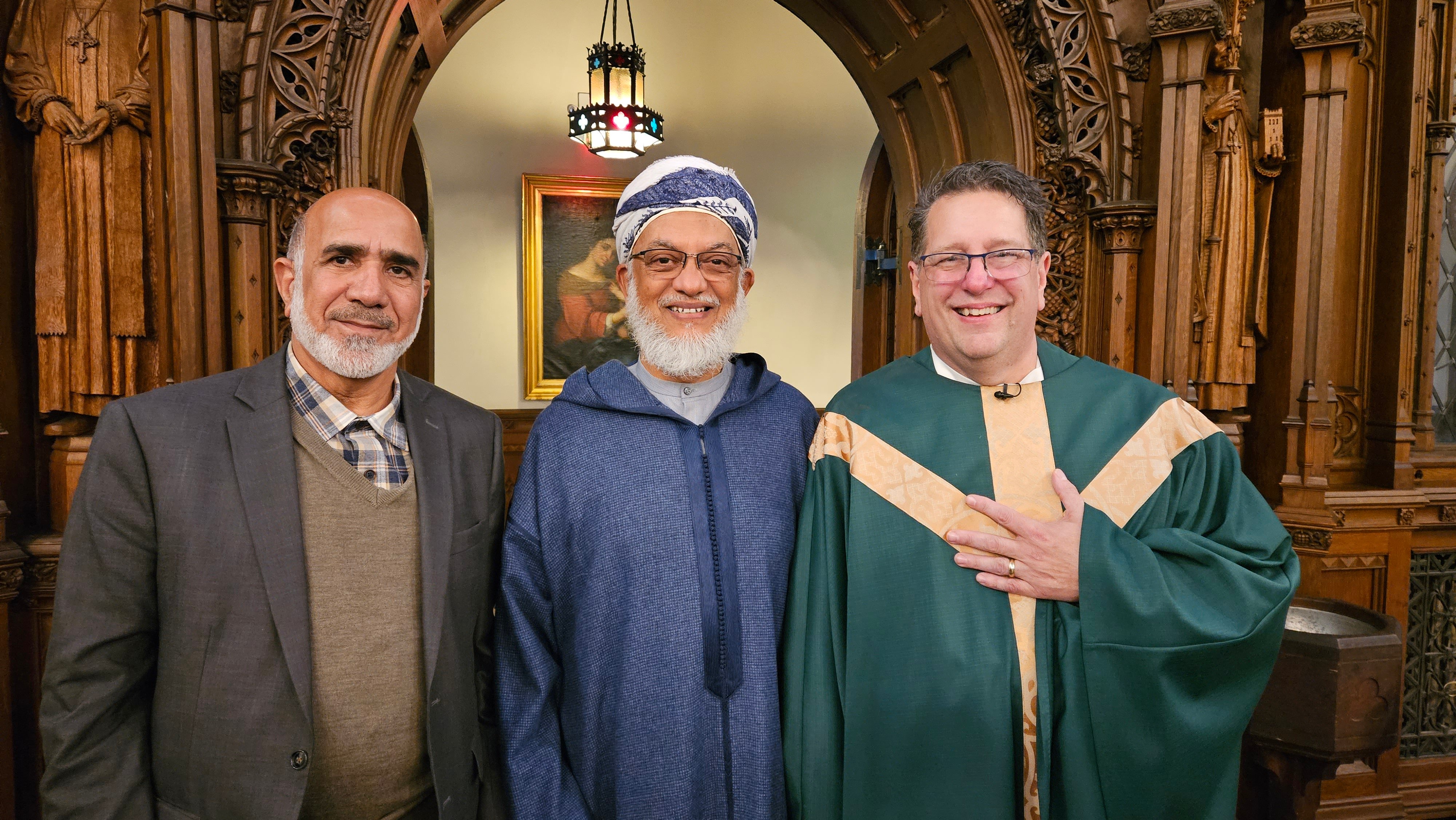
With Rev. Tom Callard (Late) and Dr. M. S. Bajwa
My last sermon, before we returned to India was at the First Church, Hadley where my dear friend Rev. Lori Souder is the Priest. Best known for running like the wind - but not always landing safely. So, Lori, please stay grounded. You are too precious. Here is that sermon.
First Church, Hadley, September 22, 2025 - Stand up if you are alive
I have two wonderful friends with whom I used to go on long walks followed by breakfast. This was so enjoyable that my only regret is that we couldn’t do them often enough. One is Rev. Jason Seymour, Head of the Unitarian Church and of the Interfaith Council of Greater Springfield. He with the Orange Laces. The other was Rabbi James Green, Head of Jewish Family Services, an organization that helps refugees to settle in America. Interestingly the vast majority of their clients are Muslims from Iraq, Syria, Afghanistan and other Muslim lands. It is beyond the scope of this article to write about all that we used to talk about as we walked around the 5 mile, figure-of-8 walkway around Ashley Reservoir, one of the most beautiful places on earth. But I must say that these conversations were most instructive and beneficial for me in Interfaith and cross-cultural understanding.

I still maintain my connection and friendship with these dear friends. Another absolutely wonderful friend, was the Director of Spiritual Affairs at Springfield College, David McMahon. David, I miss you very much. A man with a more compassionate heart, I have never met. What more can I say? I won’t go off into listing all the others who I think of with great warmth and affection and who I hope I will meet again sooner than later.
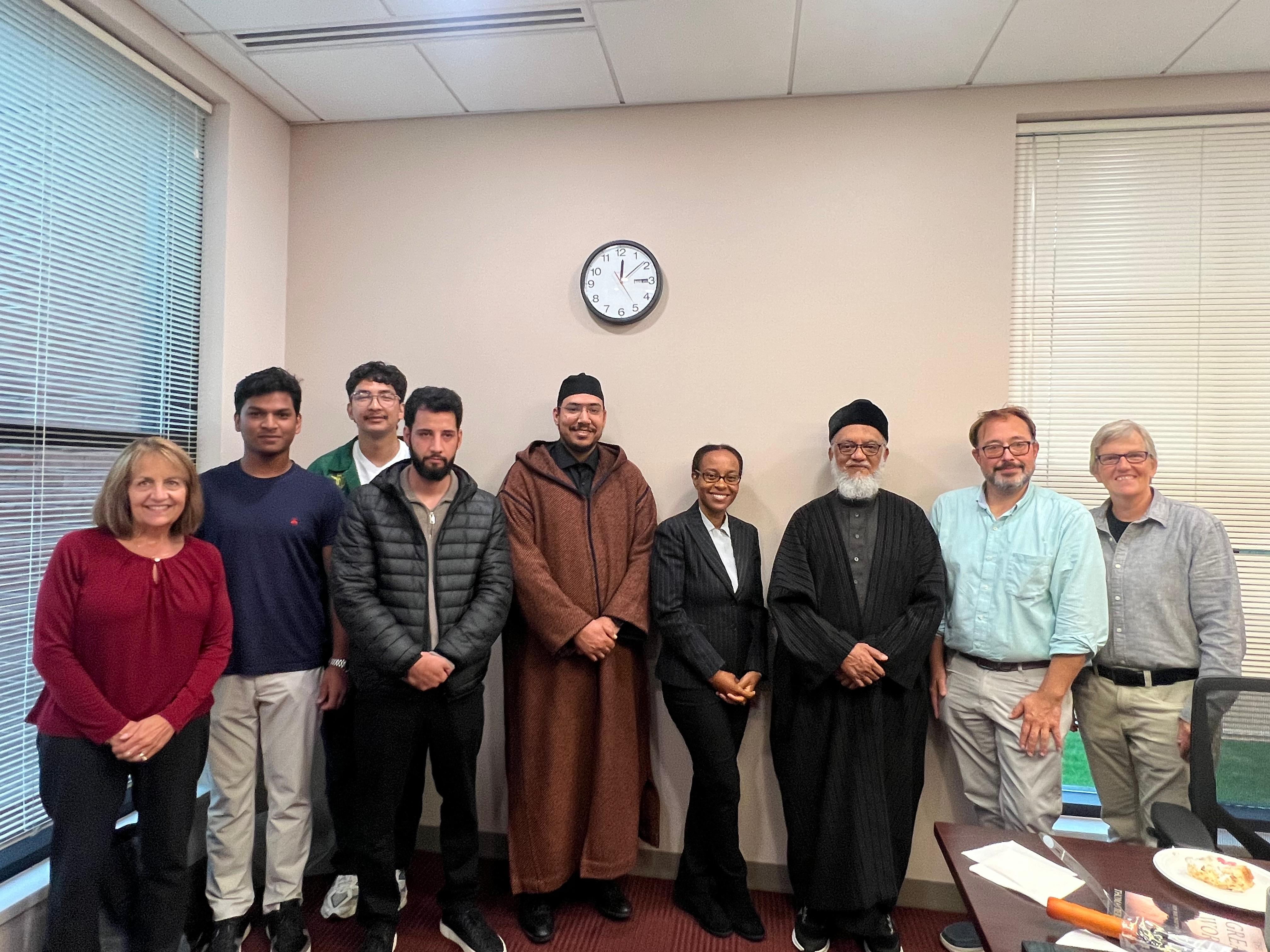
David on my left and Slandie on my right at my farewell at Springfield College
And then there is Rev. Patrick McMahon. My partner, friend, brother and more. He would come to every Juma Khutba that I did and bring his prayer mat and pray with us. In ISWM, in 2022, I taught a course on Aqeeda Tahawiyya (Islamic Creed), over several weeks and Patrick and his wife Jean attended every class. The most kind hearted and helpful couple that I have ever known.
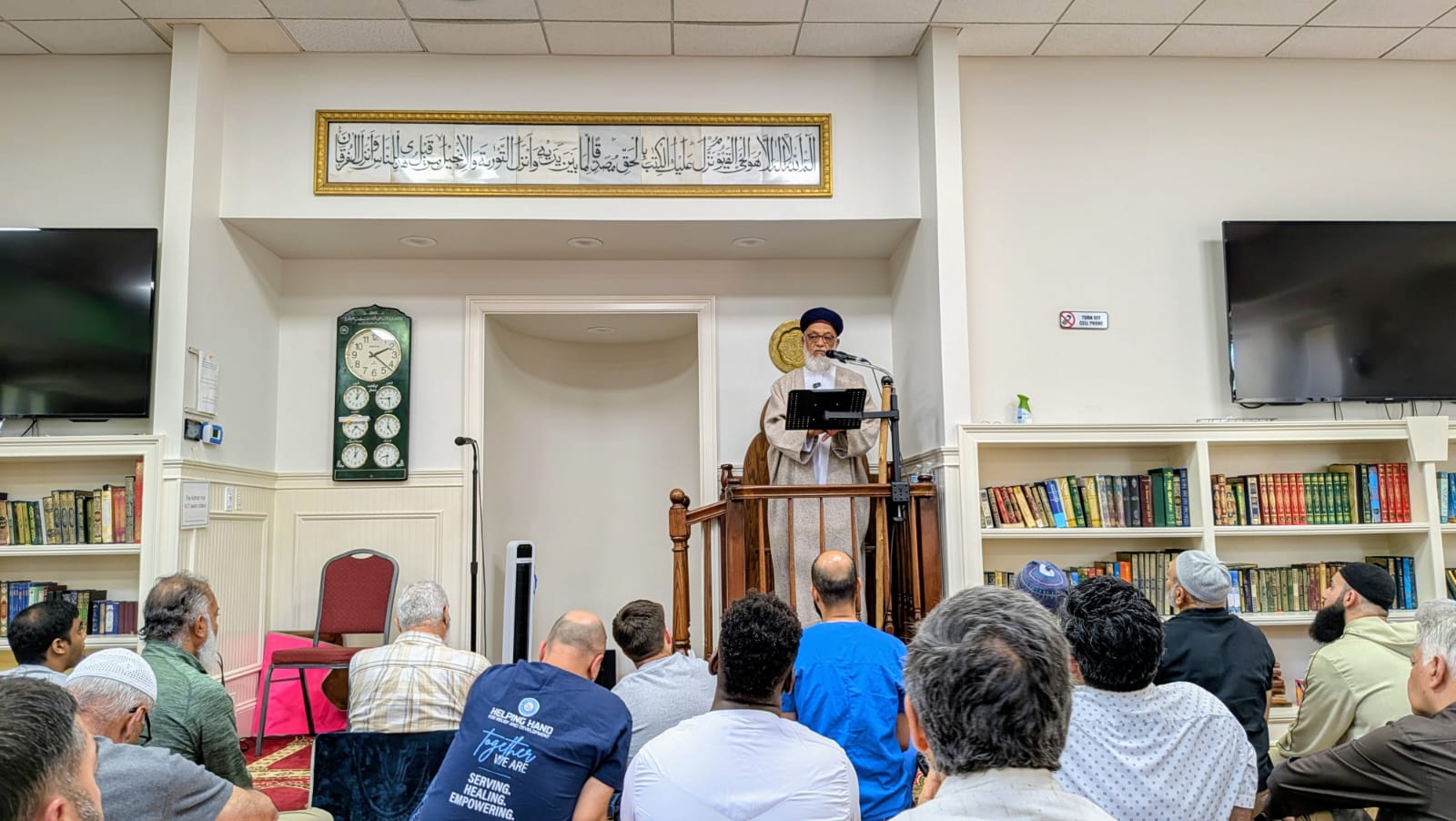
One day, there was news that the Northern Lights were going to be visible in Massachusetts. The location was in the area that Patrick lives. I called Patrick to ask for advice about where to go to see them. We needed an open area away from any town so that the sky would be dark enough to see them. Patrick said, "Just come to my place and I will take you. I will have some coffee ready. If you like, I can come and pick you up." I had my dear friend Anel (Bosnian) who also wanted to see the Aurora, so I told Patrick that we would meet him at his place. He took us up hill and down dale all night almost until morning, stopping enroute to drink strong black coffee, and we saw the Northern Lights - not the spectacular displays further north but still impressive. Heart of gold, Patrick McMahon. I am proud to have you as my friend, Brother.

In my seven years in America, I made many more friends among the Interfaith Community, but this will suffice for this article. My purpose in writing this is to encourage you to get out of your cocoons and open your eyes, ears, hearts, homes and Masaajid to the people, who Allahﷻ sent you to introduce Him to. That is not going to happen unless you learn to communicate, to relate, to build friendships, and to share your life.
In my opinion, the best and most effective counter to Islamophobia is not public speeches and social media keyboard battles. It is meeting and greeting someone of another faith. Drinking coffee with them. Listening to them. Sharing our our spaces and food. And when they ask, sharing our beliefs, hopes, and aspirations. Let people see and experience first hand, the beauty of Islam in behavior and action. In our homes, mosques, businesses, events, festivals and social circles. You will see how similar we all are at our core, human levels.
That way they will have a positive personal experience to answer the bigotry they encounter on social media or elsewhere. That is the bridge building I mentioned earlier. That is what connects hearts, so that when and if the time comes, they will answer Islamophobia, on your behalf.
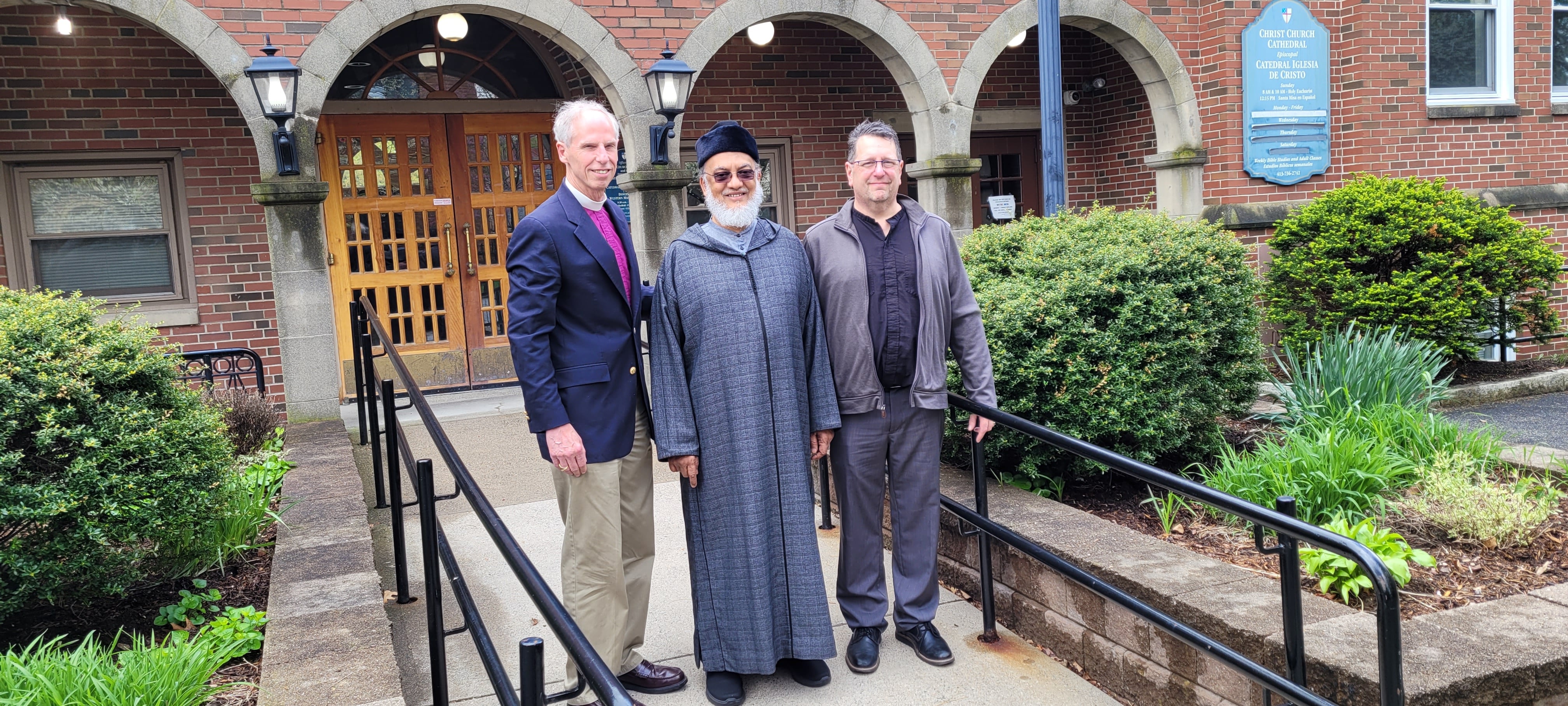
With Bishop Doug Fisher and Rev. Tom Callard (Late) outside the Cathedral
Comments (0)
Please log in or sign up to leave a comment
Loading comments...