Let me begin by two quotes from an article called Beyond these Stone Walls by By Fr. Gordon J. MacRae – “Daniel Patrick Moynihan wrote: “From the wild Irish slums of the 19th Century Eastern Seaboard to the riot-torn suburbs of Los Angeles, there is one unmistakable lesson in American history: A community that allows a large number of young men to grow up in broken homes, dominated by women, never acquiring any stable relationship to male authority, never acquiring any rational expectations for the future — that community asks for and gets chaos.”
The United States has less than five percent of the world’s population, but twenty-five percent of the world’s prisoners. The U.S. has more young men in prison today than all of the leading 35 European countries combined. The ratio of prisoners to citizens in the U.S. is four times what it is in Israel, six times what it is in Canada and China, and thirteen times what it is in Japan.
Our boys are spaced out. We have a major boy-raising problem which should be addressed urgently. Boys are raised badly thanks to a combination of disinterested fathers and overindulgent mothers. Mothers ruin boys. They don’t ruin girls. Girls are taught boundaries, manners, caring, responsibility and accountability. But not boys. Especially not in Middle Eastern and South Asian cultures. Boys are indulged and their hormone induced bad behavior is tolerated and indulged and explained away as, “Boys will be boys.” That leeway is not given to girls. Girls don’t need to deal with testosterone, which in adolescent boys can become a huge problem, especially in today’s culture where there seems to be no way to expend it in strenuous, potentially dangerous pursuits. Scrolling screens is not strenuous though dangerous. Boys need to test themselves in tough, potentially dangerous situations, to find their equilibrium and grow into men. For this they need supervision from positive male role models to develop healthy masculinity, emotional intelligence, and self-worth. Involved men—fathers, uncles, or mentors—provide a model for identity, discipline, and respectful behavior, helping boys navigate emotions and reduce behavioral issues. Remember “village”?
This problem is exacerbated in wealthy families where boys live on the expense accounts of their fathers. That is the worst crime that you can commit against your child. When he is conditioned to live in a state where he doesn’t need to earn anything and every need is satisfied because of who he is, not what he achieved, he becomes a parasite. When you condition him to believe that whatever doesn’t come automatically will come if he asks for it, you have taken away all his initiative and courage and made him a beggar in a designer suit. He grows up with an entitled attitude which takes away his ability to lead others, build and work in teams, have a healthy and happy marriage, and raise emotionally stable children. He is entitled and expects the world to conform. When that doesn’t happen, he is lost and emotionally adrift, directionless. This state manifests itself in antisocial behavior, breakdown of relationships, anger, depression, and despair. He doesn’t know how to deal with authority, or to exercise it. The good news is that this is not inevitable. It is avoidable if there is the will in the parents.
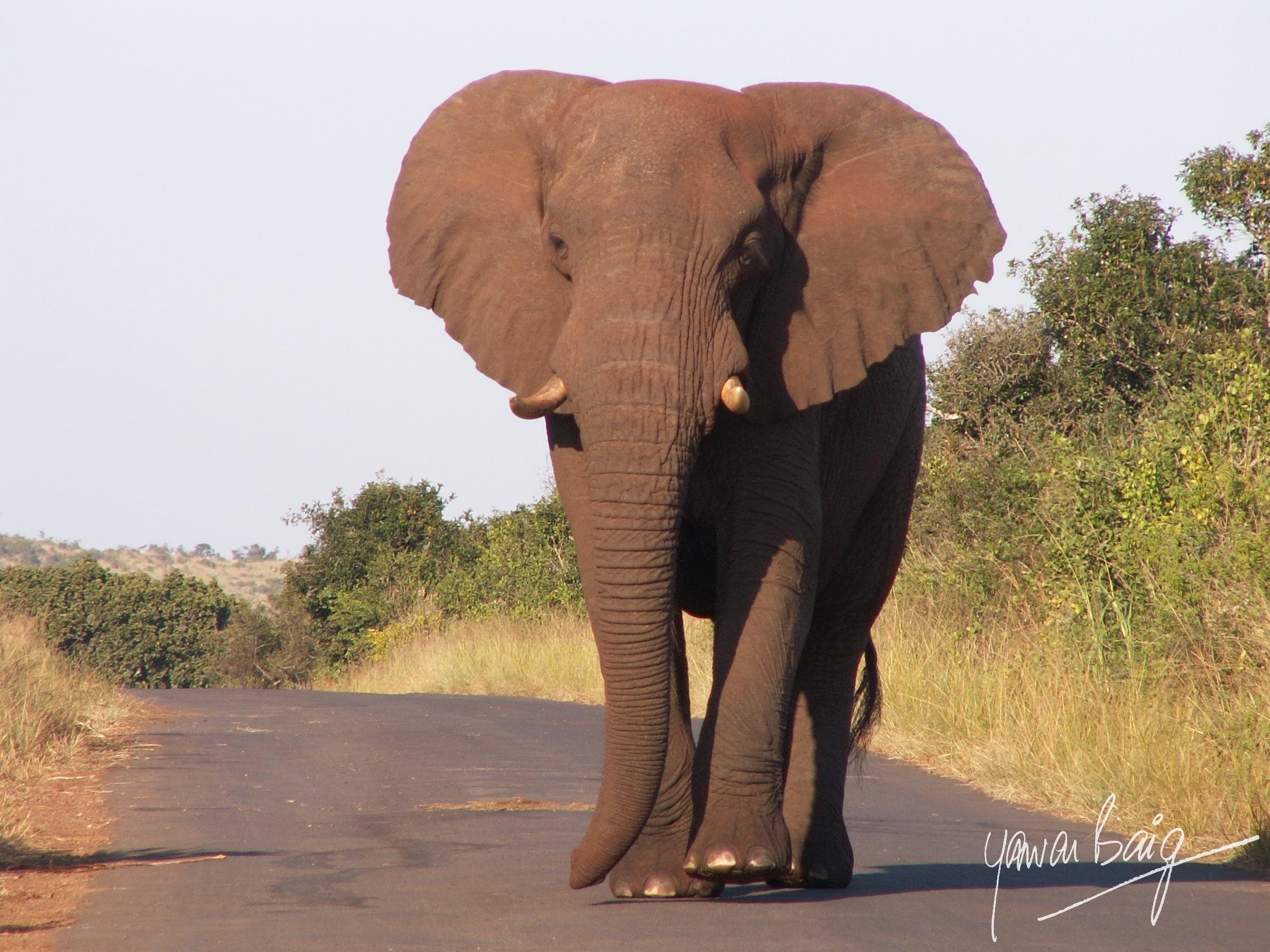
Consider this. In the 1980s and 90s, to deal with the problem of overpopulation of elephant herds in Kruger National Park, many elephants were relocated to Pilanesberg and Hluhluwe-uMfolozi National Parks. Since they were airlifting individual animals by helicopter, they found that it was easier to do it with cows and adolescent calves, and so that it what they did. The big bulls were left behind because they were too big and difficult to handle. However, after a couple of years they found that over 60 endangered white and black rhinos in Pilanesberg and Hluhluwe-uMfolozi Parks had been killed and mutilated. They found the carcasses with wounds to the head and shoulders with deep stab wounds inflicted by tusks. Camera footage confirmed the findings. Without older, mature bulls to teach them social protocols and regulate their excessive "musth" (a hormonal, aggressive state), these adolescent elephants became "delinquent" and aggressive and were killing rhinos, just to show off.
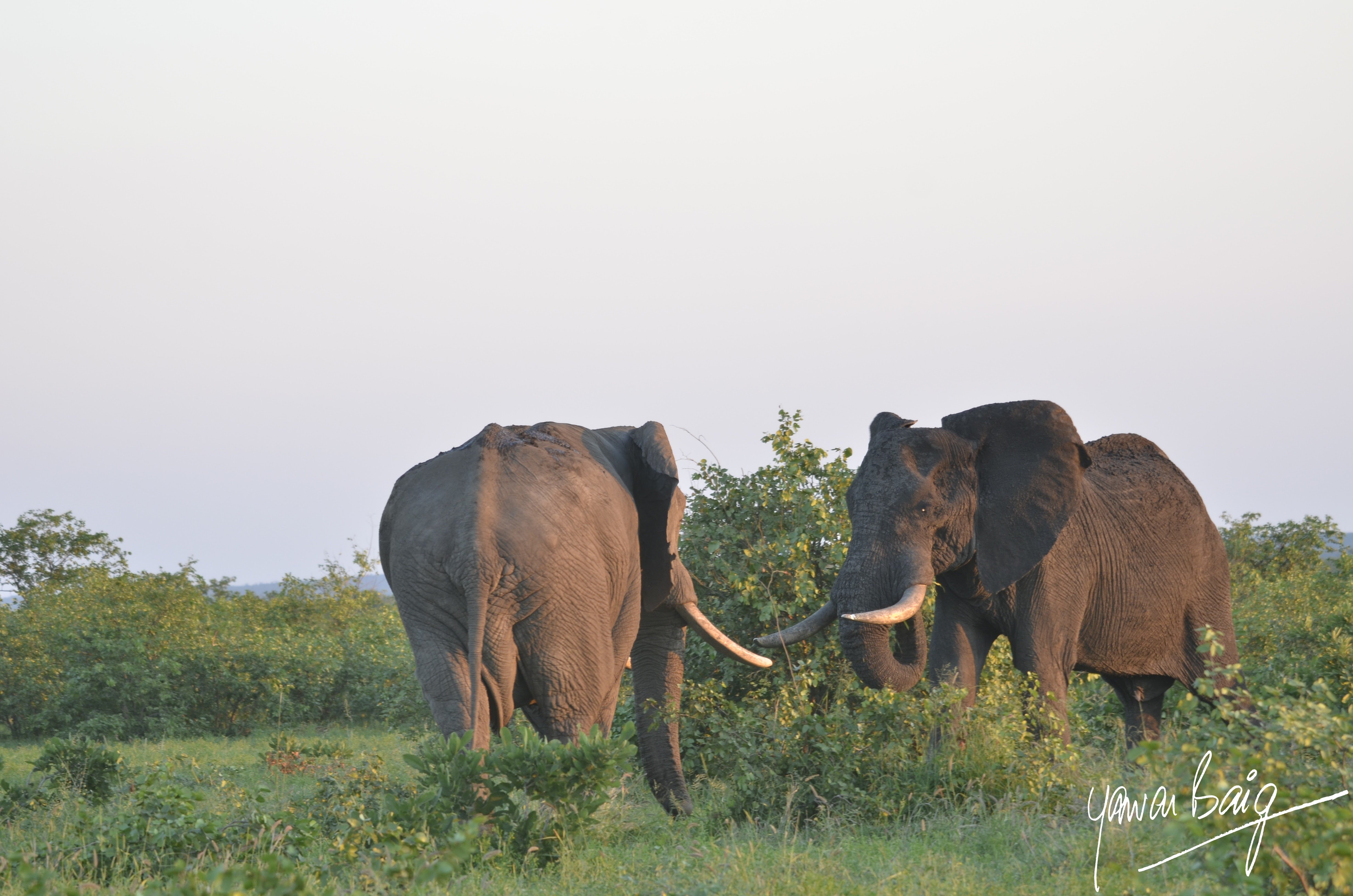
Old bull and his attendant - Askari - in Kruger National Park
The problem was solved by introducing older, large bull elephants (aged 30-45) from Kruger into the parks. The presence of these mature males established a hierarchy, and through direct intimidation and suppression, the young males stopped killing rhinos. As soon as there was a big male elephant within reach, the adolescent males dropped out of musth and became docile. All their toxic aggressiveness disappeared. This, say psychologists and ecologists, demonstrates that male elephants need, and have, strong father figures to teach them social behavior, which is vital for them to be part of a community. This applies also to boys and men.
Without strong male role models to guide and direct boys and make them men, we get - cute looking clothes hangers without any real worth, living off their father's wealth, indulged and doted on by their mothers. But they know their reality in their own hearts, believe me. No matter whatever fancy gadget they use or drive or wear, they have low self-worth because they know that they have never done anything worthwhile on their own, never achieved any great goal, never overcome any great challenge, never felt pain, never wept tears of frustration and fear in the night, yet got up the next morning to carry on, never sweated or bled, never had their back to the wall and a life threatening situation facing them........I can go on but this is enough. The tragedy is that it is not their fault. They never achieved anything because they were never given a chance to do so. This is one of the root causes of marriages breaking up. The man is not really a man except in terms of gender. That is not enough by far and so he is unable to be a role model or inspire respect in his family.
Strong sports programs where boys play team games is a good way to inculcate discipline, responsibility, combativeness, willingness to take pain to reach a goal, collaboration, willingness to pass on personal benefit for the good of the team, concern for team members and the sporting spirit. All eminently desirable and necessary. So also are Prefectorial programs in schools, where they exist. In the Hyderabad Public School, where I did my schooling, we had a Prefectorial program where students are appointed as leaders and mentors. This is done by a combination of student elections combined with class teacher's (and other teachers) recommendation. The purpose is to give promising senior students leadership opportunity and responsibility, and the authority to help maintain school discipline and assist staff. The group of prefects is often referred to as the Prefects' Council or Prefect Board. Leadership titles were Head Boy / School Captain / House Captain and so on. Prefects act as role models, monitor behavior during breaks, help younger students, organize events, and act as a bridge between students and faculty. The selection process culminates in an "investiture ceremony" during morning assembly where they receive badges. To become a Prefect was very sought after goal which resulted in channeling the energy of boys with leadership ability and drive in a positive direction. The reality is that it is this energy and leadership ability, if not channeled in the right direction, follows the Law of Entropy and creates criminal gang leaders or their equivalents. Teachers in schools like mine played a teaching plus role by being role models for students.
One incident which another student told me about illustrates what I mean. He said that one night, he and three other friends decided to break bounds and go to see a late night movie. For us Boarders, night curfew was strictly enforced and nobody was permitted to leave the dorm, let alone the school, after 9.00 PM for obvious safety reasons. Anyone who broke this rule could be expelled. So, the risk these boys were taking to see a movie was very serious. As they were standing at the bus stand outside the school, to their great surprise, they saw the Principal, Mr. K. Kuruvila Jacob's car drive up. And to their horror, it stopped at the bus stop.
Mr. Jacob rolled down his window and asked, "Where are you boys off to?"
The ring leader said, "Good evening Sir. We were planning to go to Plaza cinema to see a movie."
"You know that this is against the rules and can get you expelled, right?"
"Sorry Sir."
"Get in the car". They got in. What else could they do?
"Driver, please drop me home and then take the boys to Plaza cinema and drop them there and come back. And you boys, please see me in my office at 9:30 AM tomorrow."
There was total silence in the car as the Principal was dropped off to his bungalow in the school and while they were being driven to the cinema. Next morning in the Principal's office, the four boys who had by now acquired great notoriety or renown, depending on who you asked, just got a stern lecture and were sent off. They were not expelled or reported to their parents, even though they had been caught red-handed by the Principal himself. Inspiring others to follow you in doing something which is against the rules and can get you into serious trouble, demonstrates bad judgment, but it also demonstrates leadership. Once the individuals realize their bad judgment and acknowledge and regret it, being treated with dignity reinforces positive behavior in the future rather than rebellion. Men who make the best role models excel at this and inspire youngsters to be the best that they can be.
I was very fortunate in that I had very strong male role models when I was growing up. Just to illustrate how that worked, here is a true story from my childhood.
It was 1972 and I was 17 years old. As usual, I was in Sethpally, Adilabad. A remote little village without electricity, road, post office, bank or hospital. I was with Uncle Rama, with whom I used to spend my summer and winter vacations. Uncle Rama lived in a cottage on the bank of the Kadam River, with three huge Tamarind trees in front of it, between the cottage and the river. Tamarind has the coolest shade of any Indian tree and these three provided thick shade which combined with the effect of the river, reduced the temperature under them by several degrees. On days when I was at home in the day, which were very few, I would sleep after lunch on a cot, under those trees. To get to Uncle Rama's place you had to walk through fields and patches of forest for about two miles or so. The house was rectangular in shape with a central room which was also a passage to go from the veranda in front to the veranda behind at either end of which was the kitchen and a bathroom. A room you bathed in, in the winter. Not a toilet. In the summer you had the option of bathing at the well, where you stood on the apron and someone drew water from the well in a bucket and upended it on your head. Thoroughly delightful way to have a bath in the very hot summer.
This central room had a square table with four chairs around it. It was supposed to be the dining room, but we never ate there. The table was used as a surface to put anything we wanted handy. To one side in this room was a Westinghouse kerosene refrigerator in which we sometimes made ice cream. On either side of this central room were two equal sized rooms with windows on the outer walls. One looking out to the veranda in front and the other to the side of the house. In the front was a wide veranda that ran the whole length of the house. There was a two feet wide and three feet high parapet wall that enclosed the veranda. It acted as additional seating and a place to rest your feet and lean back in your chair, balancing it on its hind legs. On one side of the dining room door opening into the veranda was a long table with a bench on one side and the parapet wall as the seating, on the other. There were some rope cots on the other side of the veranda. All our meals, and most of our conversation was around this table on the veranda. It was also the place where anyone who came to see Uncle Rama sat, and stories were told and problems solved. Uncle Rama would talk to me late into the night and tell me stories from his life, his opinion on various matters, his commentary on politics, stories of great hunts, stalking predators, and stories that had some worthy message for me to learn. He never preached or pontificated, never spoke top-down. I was a friend and my age was not a barrier to our friendship. He spoke to me man-to-man and it was up to me to measure up and be worthy of that trust. I can say with great satisfaction that I never let him down.
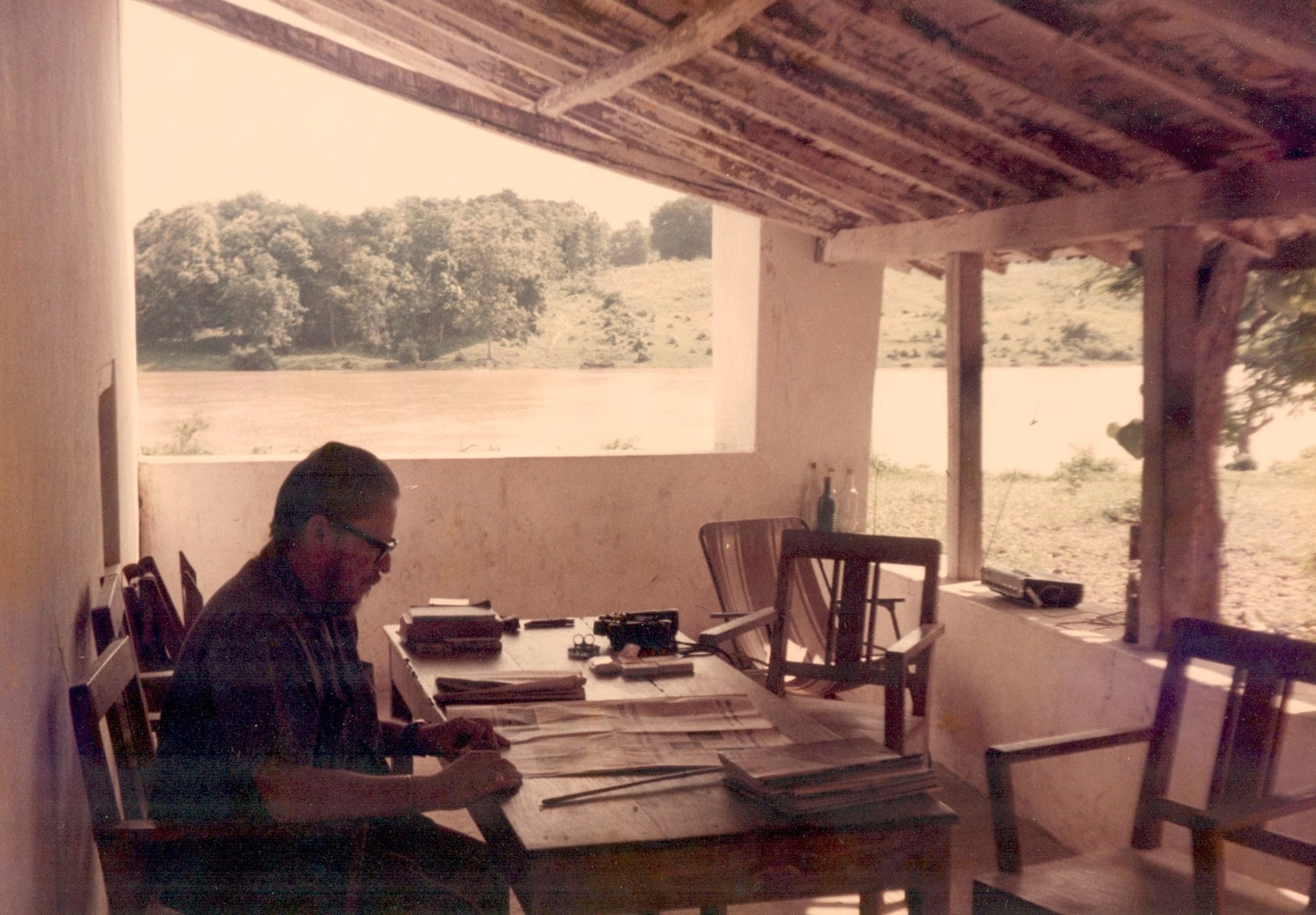
Uncle Rama and the house in Sethpally
It was summer and I had been out the whole day. My usual routine was that I would leave the house at first light, having eaten a hearty breakfast of chapattis, eggs and a large mug of tea laced with plenty of sugar (I used to take sugar in my tea in those days) and go across the Kadam River into the forest. I would usually walk but on occasion Shivaiyya would take me in his bullock cart. The bullock cart is the most versatile vehicle known to man and can do everything except climb trees. Of course, it doesn’t have springs or shock absorbers and that is hard on your back and bones, but not when you are 17. On that day, Shivaiyya and I set off walking early in the morning and took a long route that was a huge circle which would bring us back to the river in the evening. Summer days are long and so we had plenty of time. I was carrying a 7.62 Mauser bolt action carbine rifle with a 5-shot magazine and Shivaiyya was carrying a .22 BRNO rifle.
Shivaiyya was a Gond (his tribe) and was my gunbearer, guide and pal, all in one. I usually took two weapons, alternating between the 7.62 (which we called ‘8mm’ for short) and a 12-gauge shotgun, depending on what I planned to look for that day. The .22 BRNO rifle was always with me because it was useful for almost any small game. The 12-guage shotgun was mostly for duck and the 7.62 was for larger game like Sambar, Bluebull or Chital. Hunting was never my priority. But we were walking in a forest that was home to all big cats and so being armed was simply necessary, whether one shot anything or not. I almost never did.
It was a very hot day in the summer. Summer in the Sahyadris can be extremely hot with temperatures more than 45 Celsius. The deciduous forest in the foothills leading to the Kadam River is mostly teak, with a sprinkling of other species. In some places there were large clumps of bamboo. All these shed their leaves in summer and so the forest floor is carpeted with dry leaves. That makes moving noiselessly impossible. As you walk the leaves crumble loudly and make a racket loud enough to wake the dead. I walked ahead of Shivaiyya who sometimes guided me from behind. Either he would speak in a very low voice, just a word or two to ask me to either be careful or to turn one way or another. Or he would click his tongue or whistle if there was some animal or bird that he had seen but which I had missed. That didn’t happen very often, as I was very alert and had been trained in woodcraft by the greatest experts that I have ever known; Nawab Nazir Yar Jung and Uncle Rama (Mr. Venkat Rama Reddy). From them I learned above all, respect for the forest and all those who live in it. Respect is the most important thing to learn, because it enables you to appreciate your surroundings. That means that you are not careless but take care to ensure that you don’t cause any damage to anything animate or inanimate. When you act like that, you automatically keep yourself safe.
We walked all day, bathing in the atmosphere of the forest, filled with its sounds, none of them disturbing and every one of them telling a story to those who could understand. I used to play a game with myself, identifying each sound and then confirming that understanding with anything else, sound, smell, track, or sight, that I happened to encounter thereafter. After midday we sat on the bank of the Dotti Vaagu, a tributary of the Kadam which made an oxbow in which remained some water. This had a thick clump of bamboo on both banks and so it was markedly cooler. Shivaiyya and sat with our backs to large Ber bush which had no fruit at that time but is a thick and very thorny bush. When you are in the forest you secure your back first because both tigers and leopards attack from the back. Normally they won't attack humans because they don't eat junk food, but nevertheless you secure your back because that's the right thing to do. You survive in the forest and in life by knowing the rules and following them for your benefit and the benefit of others who share the space and time with you. Then Shivaiyya opened the tiffin box that he was carrying which was our lunch. Chappatis, flat omlettes, and mango pickle. We each ate two chapattis each with an omlette, dipping the pieces we broke off into the pickle until it was finished and the container wiped clean. Then we drank the water we had brought, though the water in the riverbed was also clean enough to drink. But since it was not flowing at that time, I preferred not to drink it. Once we were 'fully fed up and fulfilled', as my dear friend Berty would say - I would meet him twenty years later - we took turns to take a nap. That is another thing you learn in the wild. You always keep a lookout. Shivaiyya, though he was an illiterate farm worker/shepherd, was my teacher and mentor and I treated him as such. He reciprocated by teaching me things that I could never have learnt if not for him and which in some cases saved my life. In every case, they enhanced how I experienced the wild and reinforced my love for the wild places and those who inhabit them.
It was evening and in the tropics darkness comes quickly and we had a fairly long way to go, we started on our way back home. We had walked for perhaps three miles on a narrow winding footpath, made primarily by wildlife going down to the Kadam River to drink. Even in the hottest weather, the river had some pools in shady loops of its course which were visited by animals from all over the forest. There was no other water anywhere close, except the backwater of the Kadam Dam which was miles away. So, these pools were a very good place to see wildlife. The path took a dip and then went up a slight incline and over the top, down to the riverside. I was at the bottom of the dip walking up the incline when in the gathering dusk, I suddenly saw a Chital stag come up the path from the other side and crest the rise. The wind was blowing in my face, so he had no idea that I was on the same path as he was. I can’t say who was more surprised, but I snapped the carbine to my shoulder and fired. The shot hit him in the center of his chest. I saw the dust fly out of his hide. He snorted loudly and spun around and disappeared.
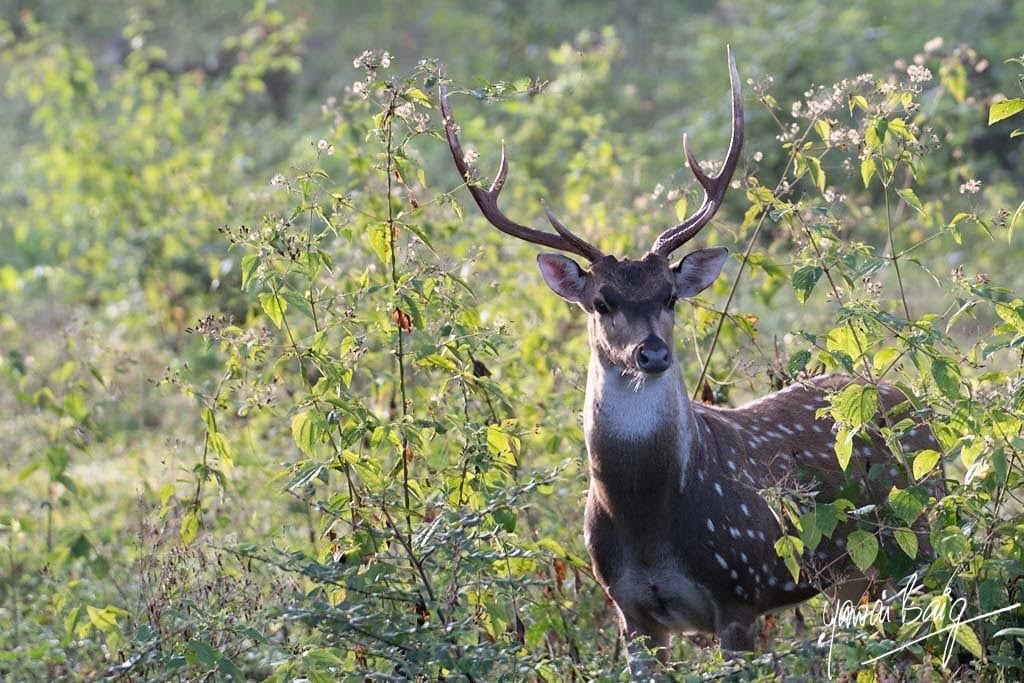
I was thrilled that my day was going to be successful after all and I would come home with some meat. Shivaiyya and I ran up the incline, expecting to see the Chital stag lying on the ground. I was in a hurry also because according to Islamic food laws, I had to slaughter the stag in the ritual way before it died, if I was to be able to eat the meat. But to my utter surprise and intense disappointment, there was no sign of the animal. It had simply vanished. Shivaiyya and I searched high and low in the rapidly falling dark to no avail. I knew I had hit him. There was some blood on the path, but it was light pink and frothy meaning that it had been hit through the lungs. His heart was intact and obviously no major bone was broken and his spine was also undamaged. The problem is that when an animal is shot with a high velocity rifle firing a solid bullet straight through the chest, it is entirely likely that the bullet goes through the animal, damages internal organs but does not break any bones. That means that often, given the massive flush of adrenaline in the animal, it could run for several hundred meters before it falls due to blood loss. There have been cases of large animals running for a couple of miles and some that perhaps lived for more than two days, before they eventually succumbed to the wound. A very painful way to die. Placing the shot is therefore very critical to successful hunting. In my surprise and hurry, that was the mistake I made.
By then it was completely dark and there was no chance of our finding the stag. Shivaiyya and I wound our way home, sad that we were returning empty handed. Uncle Rama would understand what had happened, I was sure. I was not thrilled about returning with a story instead of a quarry, but that was how life was sometimes. Or so I thought. I had no idea of the turn events would take to make that night one of the most memorable of my life.
We crossed the Kadam River, which was almost totally dry near the house, with a small trickle against the far bank which we could easily jump across without even wetting our feet. A far cry from the raging torrent filling the entire bed from bank to bank that it would become in the monsoon. As I climbed up the slope leading to the house, Uncle Rama was on the veranda and he called out in greeting to me, “Yawar baba, welcome back. Kya maray (what did you shoot)? I heard the shot.”
“I shot a Chital stag.”
“Shabaash (congratulations). Kaan hai (where is it)?”
“I lost it,” I said. And told him the whole story.
He listened in silence and said, “You are telling me that you wounded an animal and left it to die and you came home?”
“It got dark Uncle Rama. I couldn’t see anything. What could I do?”
“I am sorry, that doesn’t work. You never leave a wounded animal. You shoot straight and kill the animal outright or you follow up and finish it off. You never, ever leave an animal to die in pain because you couldn’t shoot straight.”
Well, I thought that was a bit hard, but he was the Boss, so I didn’t say anything. He said, “Right, now wash up and have your dinner and then go and get that Chital back.”
I was not sure that I had heard him right. It was almost 9 pm. By the time I’d had my dinner it would be 10 pm. He was telling me to go out into a forest with dangerous wild animals in the middle of the night to find and bring back an animal that I had wounded. Was I going to obey?
I don’t think the alternative even occurred to me. He was my mentor, I loved him very much and he loved me like his son. So, if he told me to do something, I did it, no question about it. I washed up. Kishta put the food on the table. Shivaiyya went to the back of the house to eat in the kitchen. When we had both eaten, I picked up the 8mm carbine. Uncle Rama said to me, “Don’t take that. Take the 12-bore shotgun. And take these (he gave me 4 buckshot cartridges). In the night you will only get to shoot at close range. No time to fool around with a rifle. Use this. At close range it will stop an elephant.” There was so much love (tough love alright) but love in this action of making me go into a dangerous environment but ensuring that I had everything I needed to be safe and survive. The fact that he even ordered me to go was a credit to me, that he trusted in my ability to take care of myself and treated me like a responsible adult and not just an irresponsible teenager.
Talk about mentoring? Here is mentoring for you. Teach, equip and trust. To trust means to give responsibility. Which was more ‘dangerous’? Me, taking care of myself or Uncle Rama having to explain to my parents that he had sent me out in the forest in the night and that is why I had been eaten by a tiger or bitten by a cobra? He knew that, yet he took a risk because he trusted me and needed to teach me a lesson that a gun was not a toy. Hunting was not about having fun killing animals. It was about behaving responsibly, taking ownership for your actions and accepting accountability, which means that if you make a mistake, you pay for it.
Shivaiyya and I left. There was a full moon, so the forest was a landscape of light and shadows. We came out of the riverbed and climbed the far bank and took the path leading to Shivaiyya’s village. Shivaiyya was a realist (or was he acting on Uncle Rama’s secret orders – to this day I have no idea). He said to me, “Dora let us sleep in my village and go out with the dogs in the morning before the sun rises. We will get the stag then. Trying to find him in the night without dogs to follow the scent is impossible. Getting the dogs to go into the forest in the night is impossible. What do you say?” I learnt early in life, never to argue with elders who have more experience. So, I agreed. We walked the half mile to his village. His village was a haphazard collection of mud huts with untidy grass thatch roofs. The hut had one door and no windows, and the women usually cooked inside the hut. The fuel was dried cow-dung cakes. In the night, the hut was not only home to the family but to two dogs, one goat and a young calf that was too young to be left outside with the other cattle.
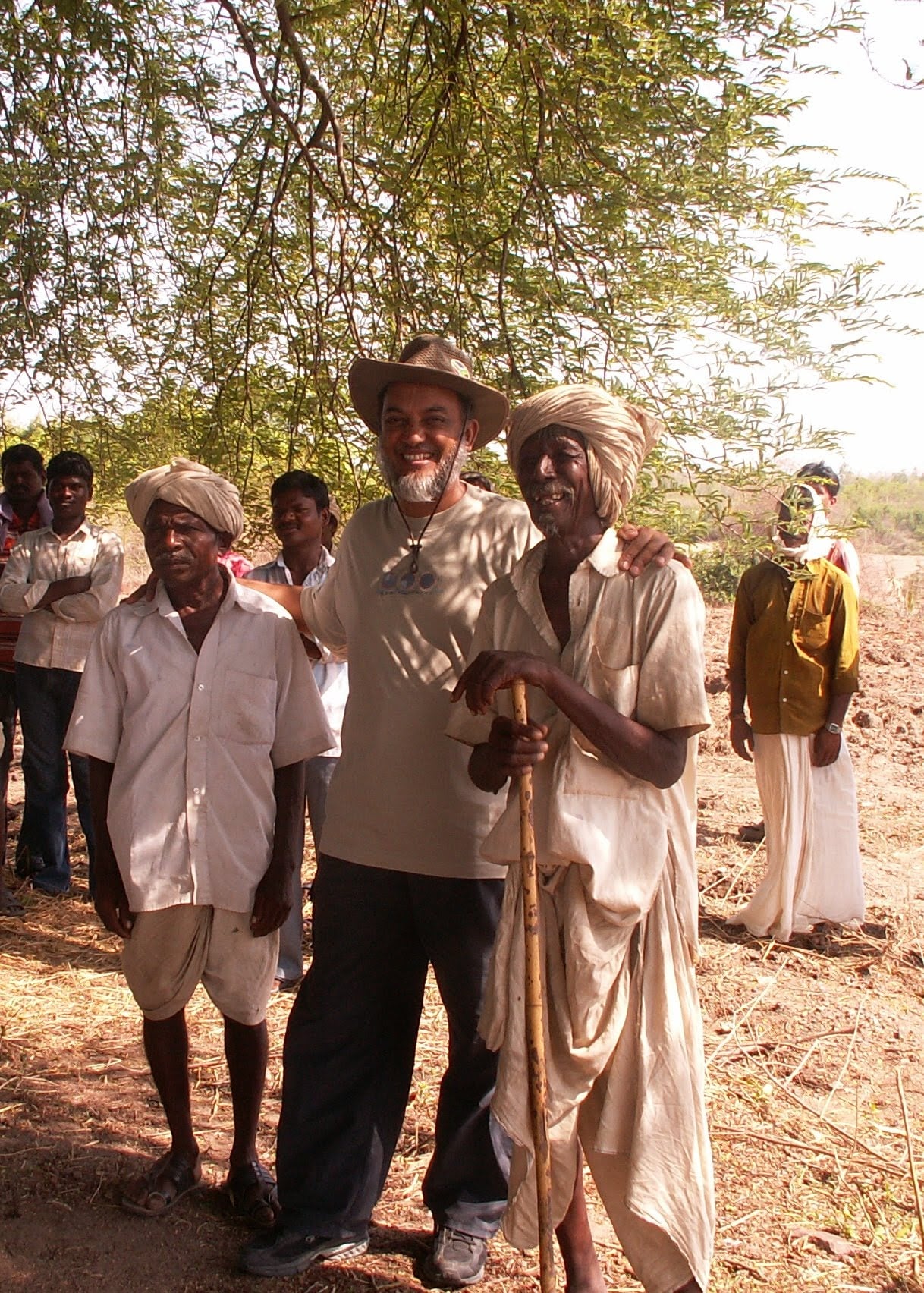
Shivaiyya on my left with the stick and Kishta - 40 years later
It was into this hut that Shivaiyya, very kindly, invited me to sleep. I politely declined and asked him to put the rope cot that he offered me, outside the hut and said that I preferred to sleep in the open. He was not happy with that, as the forest was home to tigers, leopards and bears. But I was happier taking my chances with them than with sleeping inside the hut with its smoke and multiple smells. I lay on the rope net, kept my shotgun handy and lay on my back looking at the sky. By this time, the moon had set, and the stars were out in their splendor. You must lie on your back in a forest without any ambient light and look up at the sky to understand the true magnificence of the night sky. As I lay there, I thought to myself that I was probably seeing things that didn’t exist. I mean, that the star that I may be looking at, could have ‘died’ millions of years ago, but I was ‘seeing’ it because its light reached me only now. Quite a sobering thought, if you ask me.
Long before the sun showed itself, Shivaiyya came out of his hut with sweet, milky tea, which we both drank in silent companionship. When we had finished and the light was stronger, he whistled to his dogs, and we set off to find the Chital. These are the famous Indian ‘pie’ dogs. Small curs, with a very highly developed sense of smell, and a lot of wisdom living in the jungle where they are the favorite food of leopards. So only the clever ones live. We took the dogs to where I’d first shot at the Chital, and they tracked it into a ravine where he had fallen and died the previous night. Not too far from where we had been looking for him but not having the dog’s sense of smell, we had no chance of finding him in the dark. As I had thought, my shot went straight through his lungs and out of the back. As it did not break any major bone, the animal ran away and there was also not much of a blood trail. It died eventually, but after running almost 200 yards and falling into the small ravine.
Such were my lessons in responsibility learned. Lessons about being responsible for my actions; for the consequences of my actions and of being ready to pay the price thereof. Much that I am grateful to Uncle Rama and Shivaiyya for. This is what I mean by strong male role models. What remains most vivid in my memory is the way in which Uncle Rama taught me, even the painful lessons. Firm, but full of love and respect. That is how you set boundaries for boys, which give them a sense of responsibility and teach them the primary lesson of good citizenship, that you live in this world, not for yourself alone. That you owe it to others to take care of commons, and of each other, especially if you have been blessed with more than others.
That is where external role models - teachers, mentors, uncles, coaches - make a huge difference. One because parents can't provide all the attention and inspiration that children need. Children see external role models differently from parents and see their good side and are usually more forgiving about their weaknesses. That is why it is important to have such people in your life and ensure that your children are exposed to them regularly and often. My parents allowed me to go off to Sethpally every summer and winter. They never stopped me. I used to take a bus from Hyderabad, change at two places and walk the last 2-3 miles through fields and forest. Gone without trace until I returned because there was no way to inform them that I had even arrived. But they took that chance because they realized that the learning and opportunity to develop my leadership skills that I was getting, they couldn't give me. Nobody ever said any of this out loud but now with four decades of hindsight, I can see how it all worked out. That is why they say that it takes a whole village to raise a child. Sometimes that village is dispersed all over the country.
Society, especially parents, owe a debt of gratitude to those in society, who take the time, trouble, thought, expense and emotion to invest in children who neither belong to them, nor can they be expected to do any good for them in the future. But the broad backs of such men carry the weight of legacy that another generation is taught what it means to be real men.
https://www.bbcearth.com/news/teenage-elephants-need-a-father-figure
https://beyondthesestonewalls.com/posts/in-the-absence-of-fathers-a-story-of-elephants-and-men
Comments (0)
Please log in or sign up to leave a comment
Loading comments...